Introduction
Cleanrooms are vital in industries where the control of particles, contamination, temperature, humidity, and pressure is vital. The pharmaceutical industry, biotech industry, healthcare sector, electronics industry, food processing, and laboratories all require controlled environments for different purposes.
Among the major considerations when planning for a cleanroom, it is the choice between modular cleanrooms and traditional cleanrooms.
While both systems may be designed for meeting the desired conditions, there are differences in construction process, flexibility, installation, expandability, and timeline among other factors that are significant in making choices. Differences in these factors could provide guidance to facility owners for choosing the most suitable system.
What Are Modular Cleanrooms?
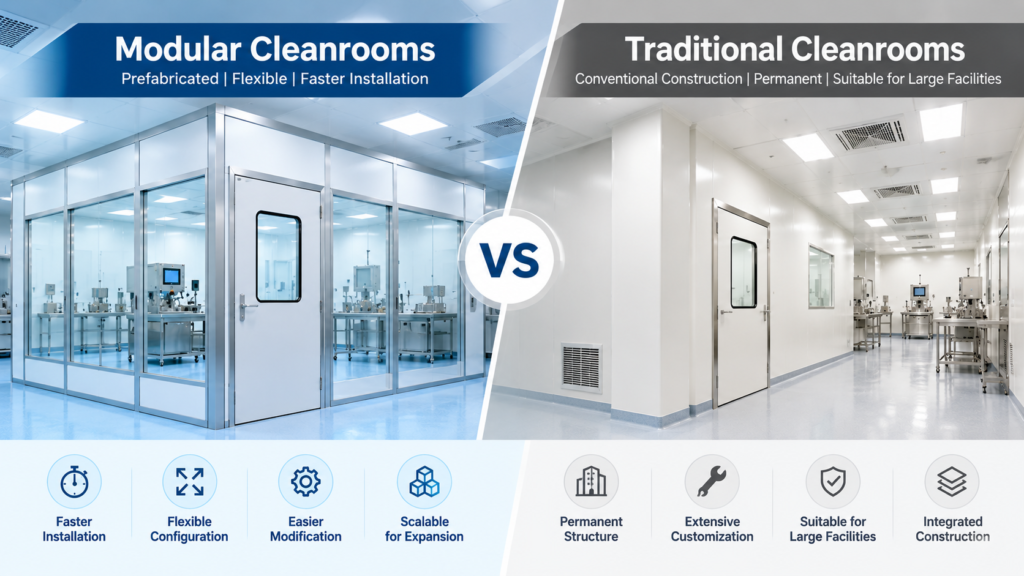
Modular cleanrooms are controlled environments that are built from prefabricated units like wall panels, ceiling units, doors, windows, and other components of a cleanroom.
These components are fabricated to specific standards and assembled on-site. In case of certain designs, HVAC systems, HEPA filters, monitoring systems, and other equipment may be installed on-site as well.
One of the key features of modular cleanrooms is their easy modification, expansion or relocation compared to many conventional constructions.
What Are Traditional Cleanrooms?
A traditional clean room usually follows the process of conventional construction. The walls, ceilings, floor, partitions, and other components might be erected right at the site with the use of materials and construction processes that will suit the function of the clean room.
Traditional construction is ideal for bigger permanent facilities where the design of the building and its production needs will not likely change in time.
Nonetheless, expansion and changes to the existing structure would mean that there would be additional construction work involved based on the original design.
Modular Cleanrooms vs Traditional Cleanrooms
There are some significant points where both differ from each other.
1. Construction Process
Prefabricated components and panels are used to construct modular clean rooms. These enable the manufacture of many parts at controlled environments prior to their installation.
For a traditional clean room, it involves on-site construction like the installation of walls and ceiling, finishing, sealing, and other construction processes.
2. Duration of Installation
Because of prefabrication, a modular system takes less time for installation compared to a traditional one.
Since traditional clean room construction involves many things that need to be done in a sequential manner at the site of the project.
3. Flexibility
Flexibility is another feature of modular cleanrooms.
In case if any changes in production take place, walls and other components of modular cleanrooms can be changed. In this case modular cleanrooms may be beneficial for the facilities which are expecting changes in the production process or production volume.
However, traditional cleanrooms may also be modified; however, structural modifications may need additional construction efforts.
4. Expandability
It is possible to say that modular cleanrooms are more flexible in case of the necessity of future expandability. Additional panels and systems may be added into existing design taking into account some engineering and facility requirements.
Traditionally cleanrooms may require demolitions, civil works, and re-construction in case of major expandability.
5. Environment During Construction
The environment during construction in case of many modular components being prefabricated may include lesser wet construction activities inside cleanroom area.
During traditional construction cutting, drilling, plastering, painting, and other similar activities will take place before start-up of cleanroom.
6. Maintenance
Maintenance of both types depends on the material type, HVAC system, filtration, equipment and operating conditions.
Panel-type construction allows easier maintenance or replacement of some parts in case if it was designed adequately.
Advantages of Modular Cleanrooms
Among the main benefits of the modular cleanroom design system are the following:
- Possibility to accelerate the installation process
- Flexibility
- Future possibility to alter the system
- Ready-made units
- Reduced disturbance during some installation works
- Applicable for expansion
- Consistent construction of panels
- Compatibility with contemporary cleanroom HVAC systems
All these features make the modular cleanroom systems especially appealing for those facilities that need flexibility and speed.
Advantages of the Traditional Cleanrooms
The traditional cleanrooms also have their own applications.
It may be suitable when:
- The facility is constructed to be used permanently
- Big spaces are needed
- There is a permanent plan of the building
- There is great necessity for integration with the building
- There is considerable architectural or structural customization required
- It all depends on the specific needs of the project.
Cost Considerations
Comparison of the cost between modular cleanrooms and traditional cleanrooms can be made only in terms of their comparative installation cost alone.
Cost factors that need to be taken into consideration include:
- Material cost
- HVAC
- Labour for installation
- Project duration
- Civil works
- Utilities
- Maintenance
- Future expansion
- Downtime
- Validation/qualification
Depending on the above criteria, one might gain from a modular solution because of rapid installation or potential reconfiguration in the future. But the reality is that it changes case to case.
Which Cleanroom System Should You Choose?
Modular cleanrooms may be suitable in cases when the project requires some flexibility, fast installation, scalability and ability to modify in the future.
Traditional construction may be suitable in cases when a large and permanent facility is to be built and its layout will not change much and a lot of integration with the building will be necessary.
This choice should be based on a comprehensive analysis of the facility’s processes, cleanroom classification, available space, HVAC requirements, potential for expansion in the future, regulatory requirements, and project budget.
Conclusion
Both modular cleanrooms and traditional cleanrooms can provide controlled environment when built and operated appropriately.
The major distinction between these types of cleanrooms is in their construction technique and adaptability to change in the future. The modular technique is based on the use of panels and can allow for flexibility and fast installation, while traditional cleanrooms can have extensive integration with building.
For pharmaceutical, biotechnology, healthcare and other applications which require controlled environments the choice should be made considering the current and future needs of the facility.