What Are Cleanroom Air Changes Per Hour?
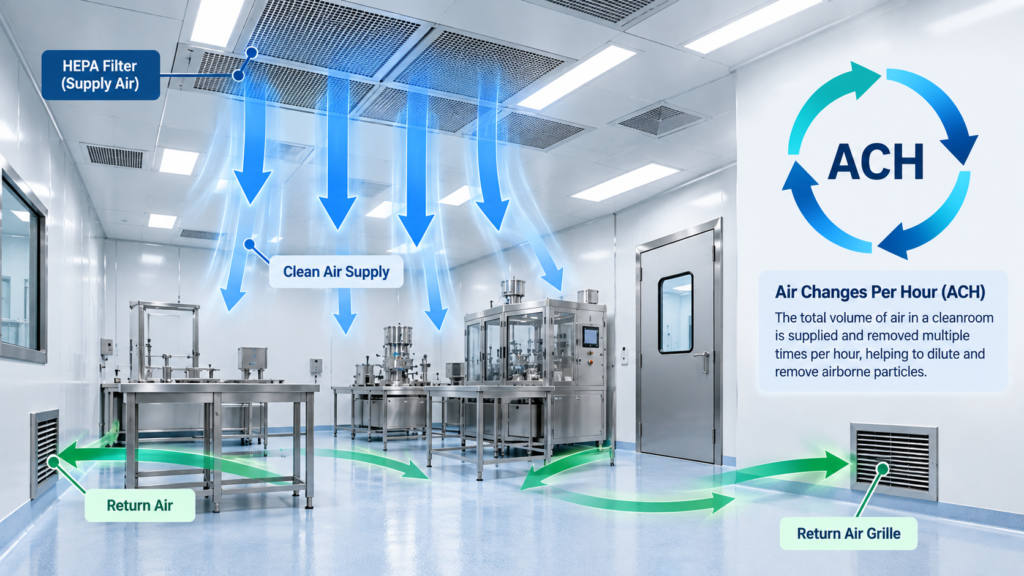
Air Changes per Hour in Cleanrooms is defined as the amount of time taken by the equivalent volume of air present in a cleanroom for circulation through the room ventilation system in one hour.
Suppose the volume of a particular cleanroom is 100 m³, and the supply rate of air to this room by an HVAC system is 2,000 m³/hour; then, the theoretical value of ACH will be:
ACH = Airflow per hour ÷ Room volume
ACH = 2,000 ÷ 100 = 20 ACH
It implies that the supply rate of air to this room is 20 times of room volume per hour.
It should be noted that ACH does not imply that all the existing air in the room is being replaced after passing the calculated volume of air through the room.
Why Are Cleanroom Air Changes Per Hour Important?
Controlled airflow is important for reducing and controlling contamination in the air.
Some of the ways in which properly-designed cleanroom air changes per hour could be helpful include:
- Maintaining controlled airborne particle concentrations
- Removing contaminants that have been created through people and process
- Maintaining the cleanliness requirement
- Temperature and humidity control
- Controlling pressure relationships between different rooms
- Enhancing environmental control
The requirements of the airflow will depend on the type of application and the design of the cleanroom. Increasing the ACH of the cleanroom does not always mean good performance in cleanrooms.
How Can ACH Be Calculated?
The following formula is used to calculate the ACH:
ACH Formula
ACH = Airflow supplied in one hour ÷ Room volume
For example:
Room dimensions:
10 m × 5 m × 3 m
Volume of room:
10 × 5 × 3 = 150 m³
Supplied air:
4,500 m³/hour
ACH = 4,500 ÷ 150 = 30 ACH
This means that the cleanroom has an airflow rate of 30 air changes per hour.
Engineers may use readings of the airflow in the HVAC system, air handling units, terminal filters or other relevant points in the system evaluation.
What Are The Determinants Of Cleanroom ACH?
1. Cleanroom Classification
The appropriate method of airflow will depend on the level of cleanliness that needs to be attained. Different classifications of cleanrooms have different requirements for particle control.
2. Number of People in the Room
Man is a common source of particle pollution in a cleanroom. A room with many people may need a different strategy of airflow from a room with few people.
3. Manufacturing Processes
Some manufacturing processes that are carried out in a room may require high air movement due to particles being produced by such processes.
4. Room Specifications
This includes factors like the size of the room, position of the equipment, ceiling height, and other internal obstructions.
5. Airflow Design
Air Change Per Hour alone does not describe how the air flows within the room. Turbulent flow, laminar flow, supply air distribution, return air location, and equipment position all affect particle control.
6. HVAC & Filtration System
The efficiency of the HVAC and HEPA filters is vital. Filters should be properly chosen, positioned, and maintained.
Can Higher ACH Improve Cleanroom Performance?
A greater number of cleanroom air changes per hour will result in a faster rate of dilution and removal of airborne particles. But high ACH does not necessarily mean improved performance.
Too much airflow increases:
- energy use,
- costs for running the HVAC equipment,
- necessary equipment specifications,
- turbulence,
- expenses,
while the proper solution consists in designing the HVAC based on contamination control needs.
How to Maintain Effective Cleanroom Airflow
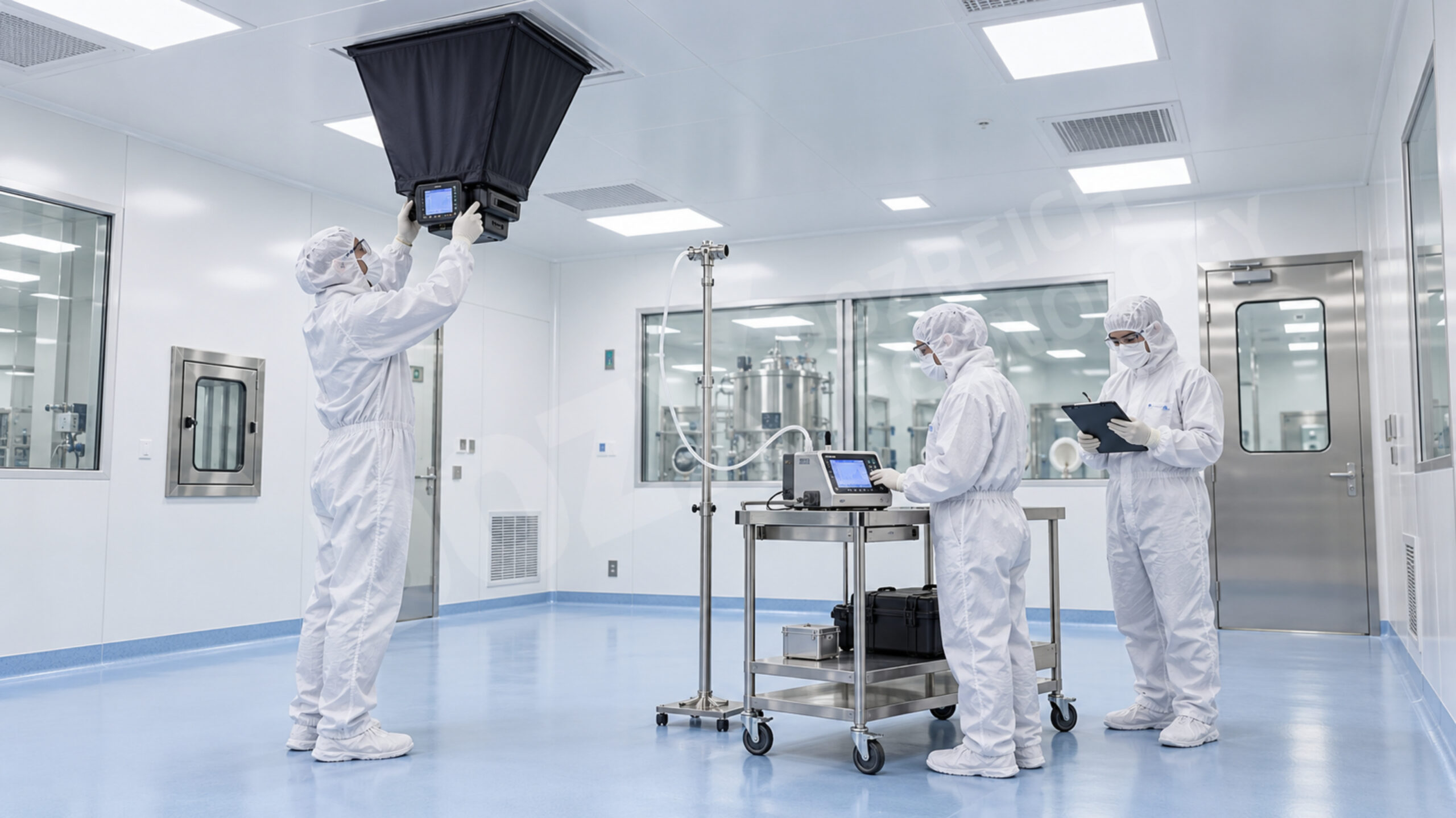
The ACH needs to be continuously monitored and maintained.
These important actions should be done:
- Checking the performance of the HVAC
- Inspecting the HEPA filters
- Checking room pressure
- Measuring airflow if necessary
- Maintaining air handling equipment
- Avoiding unnecessary movement of people
- Closing doors if necessary
- Proper cleaning
- Reviewing environmental monitoring data
Change in occupancy, equipment, room layout, or the production process may also impact the airflow design initially considered.
Conclusion
Air changes per hour is a critical factor to know when considering the understanding and design of a controlled environment. Air changes per hour offer a good guide to the amount of air available relative to the size of the room.
But one should never take into account air changes per hour without considering cleanroom class, airflows, filtration, pressurization, number of people, process requirements, and HVAC.
The correct design of a cleanroom is not done based only on high air changes per hour. The correct design should include a proper combination of air changes, filtration, pressurization, environmental monitoring, and hygienic design