What Is Cleanroom Validation?
Cleanroom validation can be described as the procedure of proving that the controlled environment is meeting its predetermined performance and cleanliness specifications.
Validation of the cleanroom is an activity involving various qualification procedures rather than a single test, which includes the following:
- Qualification of HVAC system
- Air flow test
- HEPA filter integrity test
- Pressure differential test
- Particle concentration test
- Temperature & humidity test
- Air flow visualization
- Recovery test
- Microbial test
- Containment test
According to WHO guidance, cleanroom qualification needs to be distinguished from environmental monitoring.
The importance of this distinction is due to the fact that qualification is about establishing whether the facility is meeting its requirements, while environmental monitoring is about establishing whether the environment remains under control.
Why Is Cleanroom Validation Important?
There can be changes in the facility’s airflow, pressure, filtration effectiveness or environment conditions throughout time. Such changes may not be identified without qualification and verification and, thus, may go unnoticed until production is affected.
Cleanroom qualification allows manufacturers to:
Minimize the risk of contamination
Controlling airflow, filtration and pressure can minimize the spread of contamination inside the room.
Comply with GMP requirements
Good Manufacturing Practices (GMP) require appropriate design, control, validation and documentation of pharmaceutical facilities, equipment and processes. World Health Organization
Benchmark performance
Qualification establishes a performance baseline by documenting the results of facility testing under specific conditions.
Ensure consistent manufacturing
A controlled environment increases the reliability of pharmaceutical production and control.
Identify potential issues
Testing can identify problems such as filter leakages, insufficient airflow, pressure instability or poor pressure recovery.
Stages of Cleanroom Validation
The qualification programme typically has a well-defined lifecycle.
The exact scope needs to be defined according to the design of the facility and relevant regulations.
1. Design Qualification (DQ)
Design Qualification assesses whether the facility/system has been designed considering certain requirements of the user and GMPs.
Some of the important considerations during DQ include:
- Classification of rooms
- Concept of HVAC
- Approach for air flow
- Approach for pressure cascade
- Requirements of temperature and humidity
- Movement of material and personnel
- Approach for filtration
- Materials for construction
- Cleaning requirements
2. Installation Qualification (IQ)
Installation Qualification verifies that the facilities, systems and equipment have been properly installed per approved specifications/designations.
The examples of IQ documents include:
- Equipment designation
- Component specifications
- Installation documents
- HVAC documents
- Filters information
- Instrument calibration documents
- Utilities
- Approved drawings
According to the WHO guide on qualification, IQ represents documentation of verification that facilities, utilities and equipment have been fabricated and installed per approved design specifications.
3. Operational Qualification (OQ)
Operational Qualification ensures that the systems installed are operating properly within the designated operational range.
Examples of OQ for a cleanroom include:
- Air pressure
- Temperature
- Humidity
- Air flow
- HVAC control system
- Alarms
- Interlocks
- Monitoring instruments
4. Performance Qualification (PQ)
Performance Qualification demonstrates the facility’s ability to perform in accordance with real or simulated operational conditions.
PQ may be done to evaluate the environmental performance of the cleanroom when operating under the expected process conditions.
For certain facilities, this could include particles counts, air flow characteristics, pressure relationships, environmental variables, and microbiology.
DQ, IQ, OQ, and PQ are some of the qualification methodologies outlined by WHO GMP guidelines.
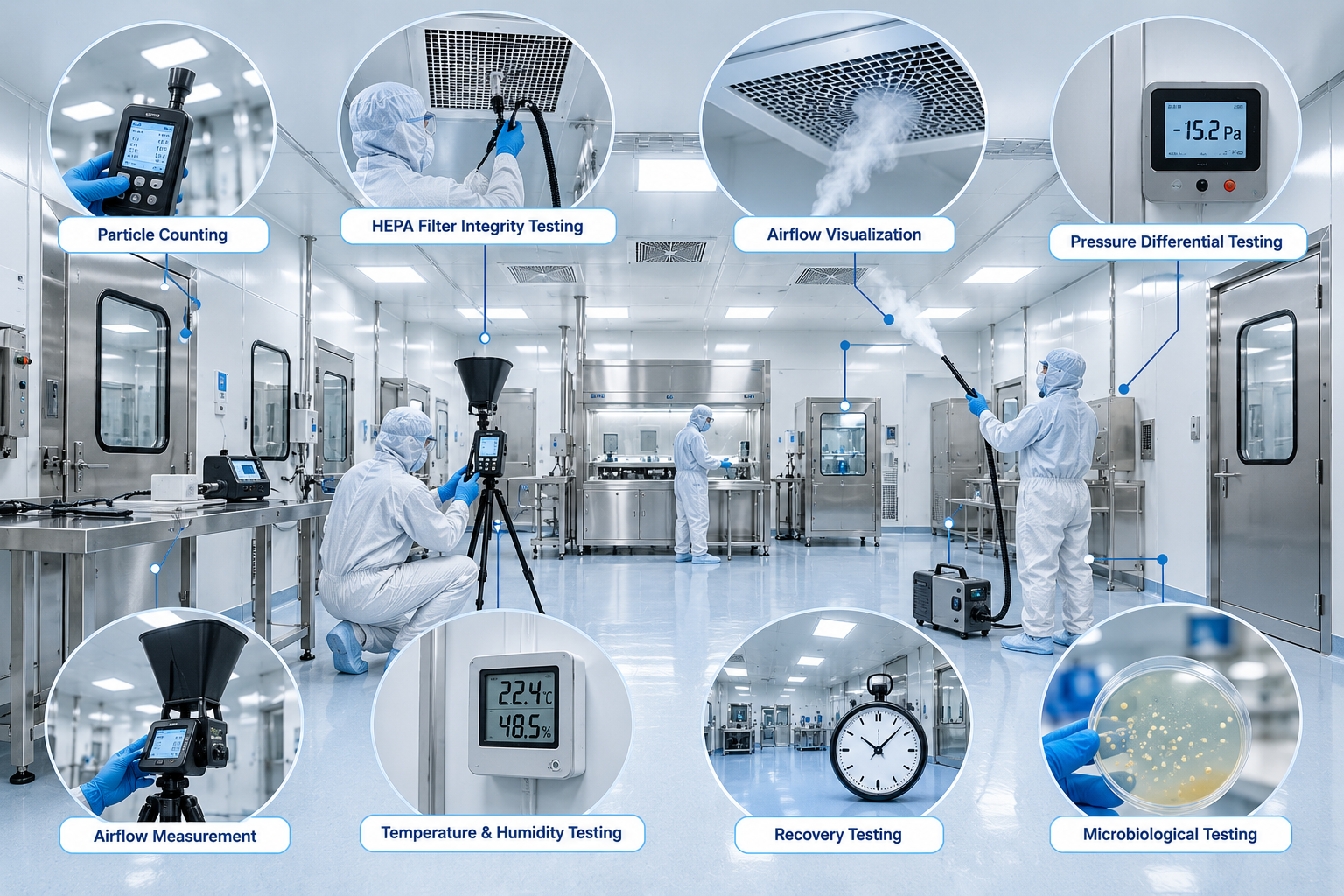
Testing Methods to Consider
The testing protocol should be developed in accordance with the design, use, and risks of the cleanroom.
WHO sterile product GMP guideline lists some qualification tests for an installation where applicable.
High Efficiency Particulate Air Filter Integrity Testing
Filter integrity test assists in determining the effectiveness of filter installation without significant leakage.
This is important because filtration defects might impair the cleanliness of the supplied air.
Air Flow Testing
Volume and velocity of air flow assist in verification of the air flow delivered by the HVAC system.
Results can be evaluated in relation to pre-determined design and operation specifications.
Pressure Differential Testing
Pressure test confirms the relationship between adjacent rooms.
Controlling the air movement between rooms with varying cleanliness requirement can be achieved through pressure cascading.
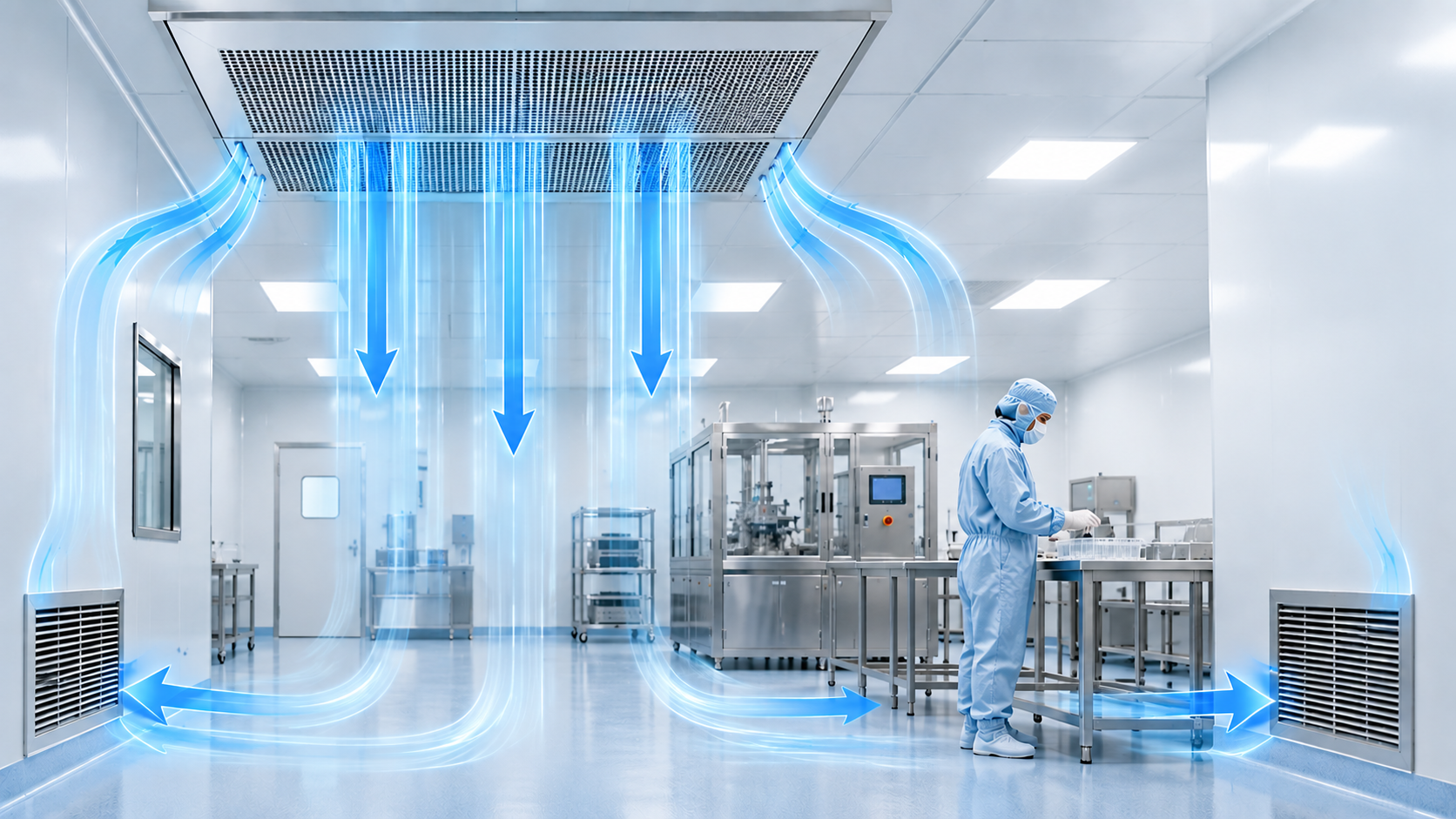
Airflow Visualization
This could be through the use of smoke studies or other forms of airflow visualization.
It can detect any undesirable turbulence, stagnation, and unanticipated airflow patterns.
Particle Counting
Particle concentration tests can be used to determine whether the cleanroom meets the required airborne cleanliness classification.
WHO lists cleanroom classification as one of the components of cleanroom qualification.
Temperature and Relative Humidity
Conditions in the environment may affect both the manufacturing process and human comfort. The tests help ensure that the temperature and humidity levels are within the required range.
Recovery Testing
The recovery test helps determine the rate at which the cleanroom gets back to its desired state after a specified challenge.
Microbiological Testing
Based on the type of facility and process, microbiological testing may be considered part of the qualification process and environmental control approach.
Documentation in Cleanroom Validation
Documentation plays a significant role within the qualification lifecycle.
The common documentation may comprise:
- Validation Master Plan
- User Requirement Specification
- Design Qualification documents
- Installation Qualification protocols
- Operational Qualification protocols
- Performance Qualification protocols
- Calibration certificates
- Test reports
- Deviations and corrective actions
- Final qualification report
- Approved drawings and specifications
- WHO guidance stresses the importance of predefined and approved protocols, as well as documentation of results and written reports as a part of qualification and validation processes.
Good documentation provides an additional tool for tracing and supporting internal quality audits and inspection activities.
Validation of Cleanrooms and Continuous Compliances
Validation must not be considered as an event which occurs only once upon qualification.
Any modifications of HVAC system, equipment, room configuration, processes, and other crucial components may influence the qualified state of the facility. For this reason, WHO GMP guidance considers qualification and validation as ongoing programmes rather than single events.
Periodic review, adequate monitoring, maintenance and requalification are important to make sure that the cleanroom continues to work in accordance with required requirements.
The frequency and scope of requalification depend on particular standards, facility policy, risk assessment and modifications made to the system.
Compliance Requirements for Pharmaceutical Cleanrooms
The cleanroom validation programme must be based on the requirements related to the particular cleanroom.
Sources of reference may include:
- WHO GMP requirements
- ISO 14644 series
- National requirements for pharmaceuticals
- Requirements for particular products
- Facility quality management practices
- Approved design and user requirements
As regards sterile pharmaceutical production facilities, WHO recommends that the cleanrooms and air systems must be qualified by applying the appropriate method of qualification, and the qualification process must include appropriate testing according to the design and operating features of the facility.
In other words, there is no universal testing list which must be followed in each particular case.
Conclusion
The process of cleanroom validation is an important part of establishing confidence in controlled environments used in pharmaceutical manufacturing facilities. The design qualification, installation qualification, operational qualification and performance qualification provide documented proof that the facility has been designed, installed and operated in accordance with predefined requirements.
Testing methods including HEPA filters integrity testing, air velocity measuring, pressure testing, particle counting, flow visualization, temperature and humidity measuring, recovery test and microbial testing can be used as proof of the cleanroom performance if they are relevant to the particular facility.
For the pharmaceutical companies, the most efficient way to deal with this issue is to make sure that the process of qualification is included in the project right from the start.