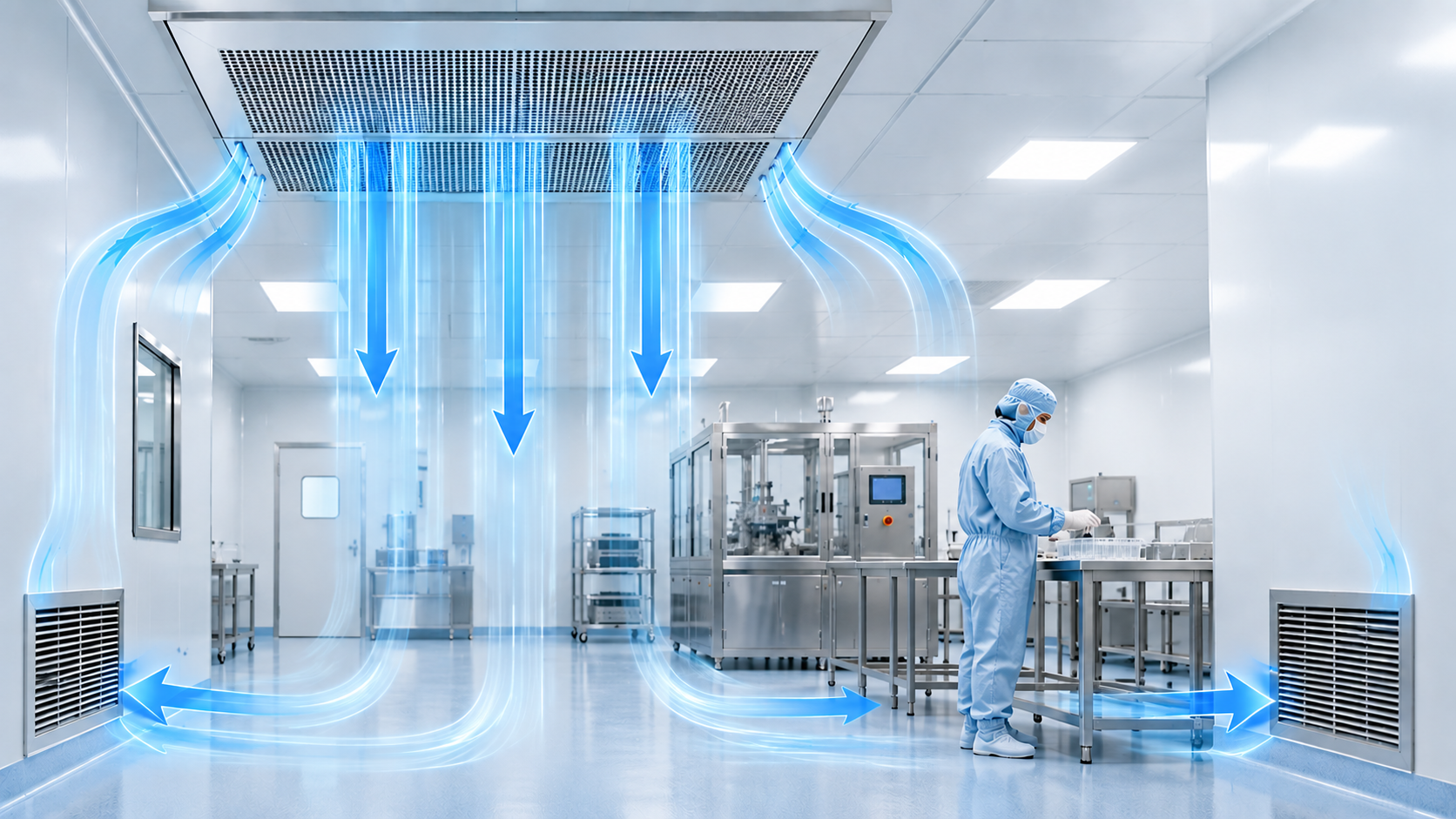
What Are Cleanroom HVAC Systems?
Cleanroom HVAC systems are specialized systems designed to maintain precise environmental conditions within controlled cleanroom environments.
Their main functions are:
- Provision of filtered air
- Control of airborne particles
- Temperature control
- Relative humidity control
- Room pressure differential control
- Airflow distribution control
- Heat removal and contaminant removal
- Provision of required cleanroom classification
The HVAC system design should take into account the cleanroom design, production process, people traffic, equipment layout, and contamination control methods.
Key Components of Cleanroom HVAC Systems
A number of parts play an integral role in meeting the required environmental parameters.
1. Air Handling Unit
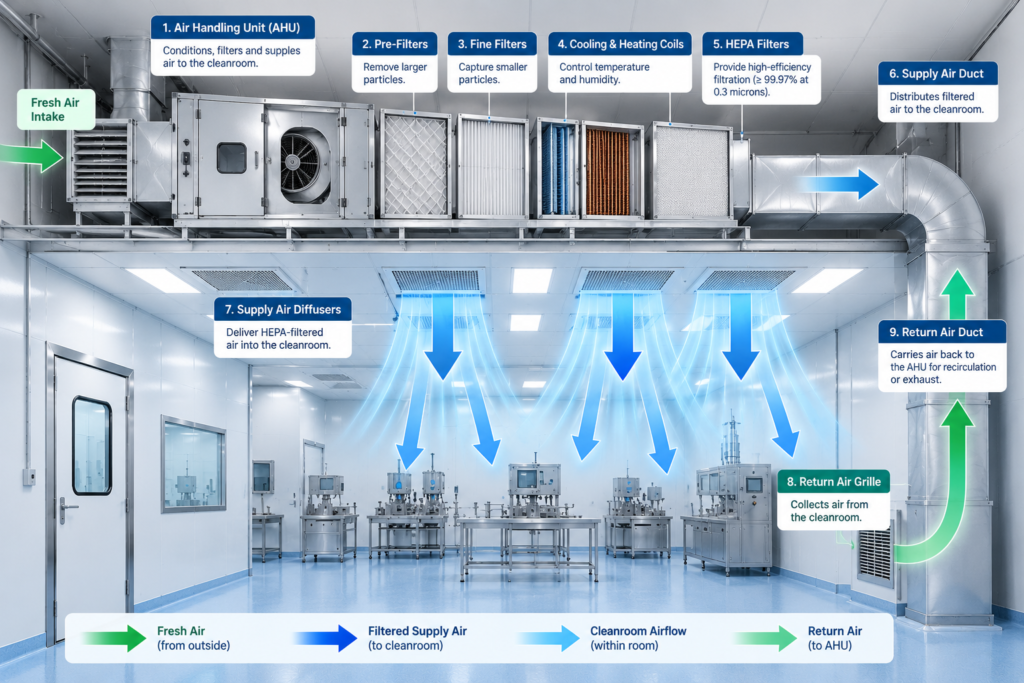
Air Handling Unit (AHU) is a vital component of cleanroom HVAC systems. It conditions the air and distributes it into the cleanroom.
An AHU system consists of cooling coils, heating elements, filters, fans, dampers, humidifiers/de-humidifiers, and controls depending upon the application requirements.
2. Pre-filters and Fine Filters
Filters are very important to remove particles from the air before entering into the controlled environment.
Pre-filters and fine filters are usually employed as stages of filtration for protection of other parts and effective performance of the system.
3. HEPA Filters
High Efficiency Particulate Air (HEPA) filters are widely employed in pharmaceutical industry and many other high grade cleanroom facilities.
Supply point HEPA filters can be used to condition air to be supplied to the cleanroom environment.
4. Supply Air System and Return Air System
The supply-air system delivers filtered air into the cleanroom, whereas return-air system draws air from cleanroom for recirculation or exhaust, as per cleanroom design.
The placement of supply and return locations greatly influences airflow and contamination levels in cleanroom.
5. Ductwork
Ductwork is used to deliver air to various locations from the AHU to filtration system and cleanroom areas.
It is important that ductwork in cleanrooms must be designed properly and sealed for minimizing contamination problems.
6. Temperature and Humidity Control
Temperature and humidity levels may influence people, products, equipment, and processes.
Cleanroom HVAC systems therefore incorporate suitable sensors and control systems to maintain the environmental ranges established for the particular process.
Airflow in Cleanroom HVAC Systems
Airflow is a very crucial consideration in designing a cleanroom.
Based on the specific application of the cleanroom, there are different forms of airflows that can be used in designing a cleanroom, which include turbulent mixing air flow and unidirectional air flow.
These include:
- Location of air supplies
- Location of return-air
- Air flow direction
- Air flow distribution
- Geometry of the cleanroom
- Location of equipment
- Movement of personnel
- Sources of contamination
Air changes per hour (ACH) are a very important design factor in many cleanrooms, although it does not define performance of a cleanroom.
Pressure Control
Pressure differential is important in ensuring proper control of air flow between areas.
For instance, one area can be kept under higher pressure than another to ensure that there is no movement of air between areas, depending on the contamination control procedure adopted in that particular facility.
Some facilities may require the use of air locks, pressure monitoring equipment, doors, and HVAC in maintaining the pressure differential.
Negative pressure areas may be necessary for containment of hazardous substances.
Important Design Considerations
Cleanroom HVAC design is not as simple as selecting an AHU and installing HEPA filters.
Classification of the Cleanroom
Different environmental requirements apply according to the classification of the cleanroom and its intended process.
Heat Gain
The HVAC system needs enough capacity for removing heat from the equipment, lighting, personnel, and process.
Occupancy
Personnel are sources of contamination and heat. This is something that must be taken into account during HVAC design.
Equipment Layout
Large equipment can obstruct airflow. The supply and return air positions need to take this into account.
Energy Efficiency
Cleanrooms need a lot of conditioned air. Energy-efficient fans, controls, and heat recovery when possible can assist in achieving this goal without compromising the environment.
Maintenance and Qualification
The performance of cleanroom HVAC systems may vary from time to time owing to filter loading, mechanical wear, control system problems, or even changes in the building.
Appropriate maintenance will involve proper inspection of filters, fans, coils, dampers, sensors, ducts, and controls.
Cleanroom HVAC systems must be appropriately tested and qualified in accordance with the requirements of the building. This might vary depending on the cleanroom and include air flow measurements, HEPA filter integrity tests, differential pressure tests, temperature and humidity checks, and airborne particle tests.
Conclusion
The cleanroom HVAC systems are important in ensuring that controlled environments are maintained in industries such as pharmaceuticals, biotechnology, health care, and others. This ensures that the controlled environment is provided with airflow, filtration, temperature, humidity, and pressure.
A good HVAC system for a cleanroom should be designed in the context of the entire cleanroom system and not just as a separate installation. The room class, process requirements, people flow, equipment, airflows, filtration, pressure, energy, and maintenance should all be considered.
Cleanroom HVAC systems, when well designed and maintained, will be reliable environmental control system for the cleanroom facilities.