What Is Cleanroom Qualification and Validation?
For cleanroom facilities, cleanroom qualification and validation may involve assessing environmental conditions such as airborne particle concentration, airflow, pressure differentials, temperature, humidity, HEPA filter integrity, and recovery performance.
The exact tests and acceptance criteria depend on the facility type, cleanroom classification, manufacturing process, regulatory requirements, and contamination-control strategy.
Why Cleanroom Qualification and Validation Are Important
The primary goal of cleanroom qualification and validation is to ensure that the environment is able to maintain the conditions necessary for the process.
In the case of the manufacture of pharmaceutical products and other sterile products, there is the need for cleanroom qualification and validation since the products may be exposed to airborne particles and microorganisms.
Some benefits of cleanroom qualification and validation include:
- Ensuring environmental control
- Determining HVAC efficiency
- Cleanroom classification verification
- Pressure differential confirmation
- Airflow efficiency assessment
- HEPA filter integrity confirmation
- Performance documentation
- GMP compliance
- Contamination prevention
- Controlled operating conditions
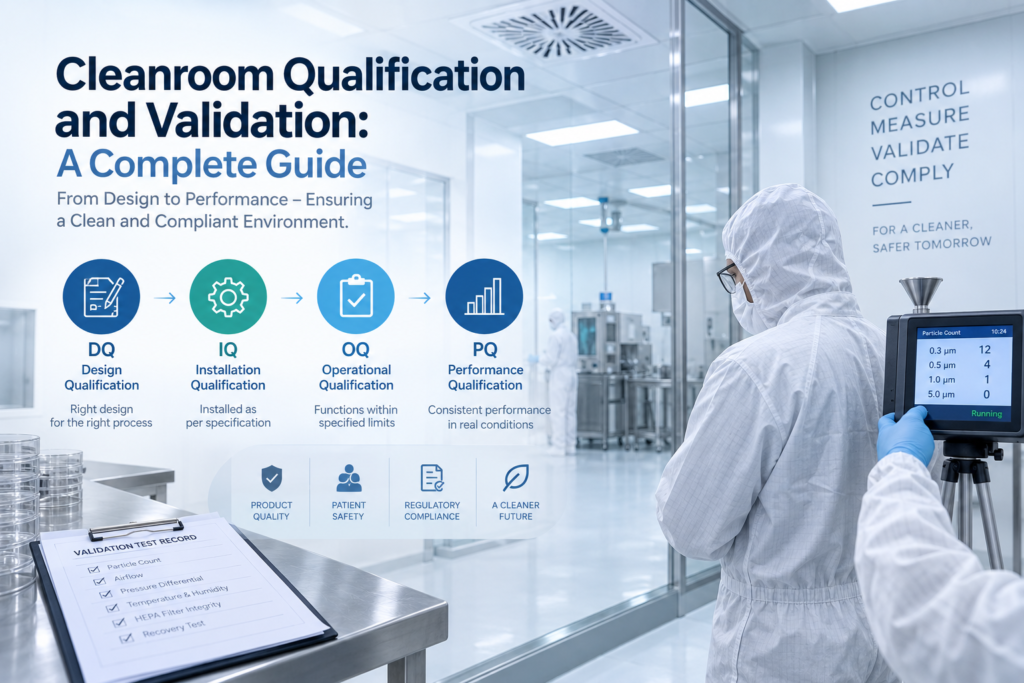
Design Qualification (DQ)
Design Qualification is often referred to as DQ, and it is a crucial phase that happens prior to installation. This phase involves checking the suitability of the cleanroom design and systems for the planned process.
The various aspects evaluated during DQ include cleanroom design, HVAC design, flow concept, classification of rooms, pressure cascading, materials, equipment, utility, and contamination control concept.
The successful conduct of this phase serves as the basis for future activities for cleanroom qualification and validation.
One scenario is where a drug company needs to have different classifications of the cleanroom. The cleanroom design should therefore consider how personnel, materials, air, and waste movement will take place between the rooms.
Installation Qualification (IQ)
Installation Qualification ensures that the systems, components, and pieces of equipment have been installed as per the approved specifications.
In case of cleanroom HVAC systems, IQ can include:
- Air handling unit
- Ducts
- HEPA filter
- Sensors
- Control systems
- Pressure monitor
- Temperature and humidity monitor
- Electrical connections
- Identification of the equipment
- Calibration of the equipment
Documentation is an integral part of IQ process. The equipment specification, drawing, certificates, manuals, and calibration records can be documented.
Correct IQ provides proof that the system is installed properly before carrying out the operational tests.
Operational Qualification (OQ)
Operational Qualification tests whether the installed systems function properly within specified operational ranges.
As part of the OQ process, the cleanroom might be put through controlled testing to see whether the HVAC systems have met the specified criteria.
Depending on the type of facility, the OQ process might involve the following:
- Volume of airflow
- Velocity of air
- Pressure of room
- Temperature
- Relative humidity
- HEPA filter integrity
- Levels of airborne particles
- Alarm systems
- Monitoring systems
OQ forms a key part of cleanroom qualification and validation processes since it gives documented proof of system functionality.
Performance Qualification (PQ)
PQ assesses the performance of the cleanroom based on operational or simulated operating conditions.
This may involve testing under dynamic conditions, where the operation of the equipment and the activities of people are simulated. Dynamic testing is crucial since the activities of people and operation can impact the level of airborne particles and airflows.
The aim of PQ is to show that the cleanroom is capable of maintaining the necessary environmental conditions in normal operation mode.
Hence, qualification and validation of a cleanroom should not be restricted to testing an empty room. Where relevant, operating conditions must be taken into account for the qualification process.
Important Cleanroom Qualification Tests
There may be multiple tests included within a comprehensive cleanroom qualification and validation process.
Particle Count Test
Particle count is performed to measure the concentration of airborne particles of specified sizes. It is useful to evaluate the compliance of the cleanroom with its declared classification.
HEPA Filter Integrity Test
The HEPA filter is a vital component of many cleanroom HVAC systems. HEPA filter integrity test allows detecting any defects or leaks that could impact the quality of filtered air.
Airflow Test
Airflow test provides data on whether the HVAC system delivers the required volume of air.
Differential Pressure Test
Differential pressure test is helpful in verifying the pressure relationships between neighboring rooms. Proper pressure relationships play an important role in controlling the airflow and preventing cross-contamination.
Temperature and Humidity Test
Temperature and relative humidity should be measured according to set requirements.
Airflow Visualization
An airflow visualization study is helpful in visualizing the flow pattern and detecting any turbulences, stagnant zones, and contamination paths.
Recovery Test
Recovery test measures the recovery time of the cleanroom to reach its stated cleanliness condition.
Static and Dynamic Conditions
There are various situations where cleanroom testing can be conducted according to the method used to qualify the facility.
When conducting cleanroom testing under static conditions, no people are usually involved nor production taking place in the cleanroom. Such testing can be helpful in identifying baseline performance of the environment.
During dynamic cleanroom testing, there are personnel, equipment and activities present in the cleanroom. This provides more data regarding performance of the cleanroom under such conditions.
In sterile pharmaceutical manufacturing, dynamic testing is given much more weight by regulation than empty cleanroom testing.
Documentation and Acceptance Criteria
Documenting is an integral part of cleanroom qualification and validation process.
Prior to conducting tests, it is essential that the criteria for acceptance are set. The test procedures, test equipment, sampling locations, responsibilities and procedures need to be developed as well.
The qualification documents can include:
- Approved protocols
- Test procedures
- Calibration certificates
- Equipment documentation
- Test results
- Deviation investigation and analysis
- Corrective action plan
- Qualification reports
- Approval records
If the test does not fulfill the acceptance criteria, then the deviation needs to be investigated and documented.
Requalification and Ongoing Monitoring
Qualification does not need to be a single event. Cleanrooms can evolve over time due to changes in equipment, HVAC systems, maintenance, filter changes, construction activities, and manufacturing process changes.
This is why facilities need to develop proper monitoring and requalification plans according to their processes and relevant regulations.
Environmental monitoring will give information about the state of the cleanroom, while analysis of the gathered data will reveal slow performance changes.
Monitoring and periodic reassessment are complementary to qualification and validation of cleanrooms.
Common Mistakes to Avoid
There are several errors that are often made when implementing a clean room qualification program.
The first one is focusing solely on particle classifications. Particle readings are critical, however, other variables like air flow, pressure, integrity of HEPA filters, temperature and humidity readings might also have to be checked.
Another error lies in lack of predefined acceptance criteria prior to the tests. Without set criteria, it is difficult to conclude that the system passed.
Documentation problems are also an issue. Each test needs to generate documentation that can be analyzed.
Finally, facilities should not make the qualification process an exercise in paper writing. The goal of clean room qualification and validation is to prove environmental and system performance.
Conclusion
Qualification and Validation in the cleanroom provide documented proof of the capability and reliability of the environment to meet its desired performance criteria. At every step of the way from design and installation to operation and performance testing, every step will help you build confidence in the cleanroom.
The right kind of planning and implementation of the qualification and validation process should take into account the cleanroom class, HVAC systems, air flow, pressure cascade, HEPA filters, temperature, humidity, particle levels, and operation parameters.
For pharmaceuticals, biotechnology, medical devices, and any other controlled manufacturing facility, proper planning and implementation of cleanroom qualification and validation process can help in achieving contamination control and process consistency.
As we at DOZX Cleanroom Solutions have experience in the field of cleanroom engineering and HVAC systems, we can assist you in setting up your business’s cleanroom facility and systems based on your process and environmental requirements.